Class Format
The Sound Sprouts curriculum is structured into the ten segments listed below.
Expand each section to find notated music, lyrics, and audio reference links.
Opening
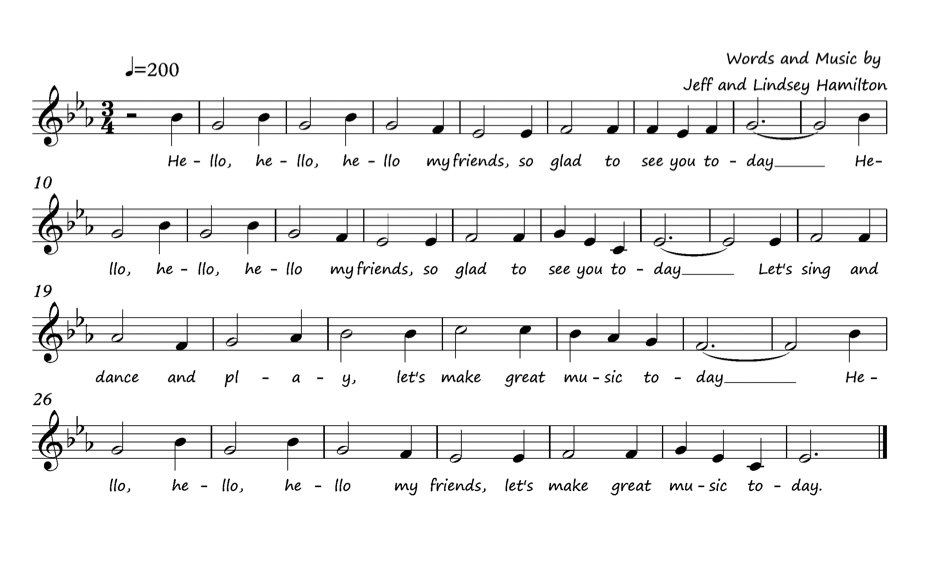
Each class will have a notable beginning by starting with the Hello Song. The Hello Song offers the opportunity to greet each child by name, and it creates a predictable start to class for the group.
Hello, hello, hello my friends, so glad to see you today.
Hello, hello, hello my friends, so glad to see you today.
Let’s sing and dance and pla-a-ay, let’s make great music today.
Hello, hello, hello my friends, let’s make great music today.
You may be tempted to eliminate this component at home to save time, considering it may be your child making an introduction to only you. This is absolutely understandable, but here is a suggestion to make this aspect more fun at home, should you choose to do it. Have your child set up some stuffed animals to be part of class. Not only will your child have fun talking to the animals, he can also create imaginary introductions for the animals.
Music Appreciation
Learning about instruments in the symphony orchestra helps children develop a deeper appreciation for classical music. Students will be introduced to the trumpet, violin, clarinet, bassoon, and piano.
- Violin: Violin Concerto in D minor, I. allegro moderato (J. Sibelius)
- Trumpet: Trumpet Concerto in E flat major (Haydn)
- Clarinet: Clarinet Concerto in A major, K. 622, II. adagio (W.A. Mozart)
- Piano: Piano Concerto No. 2 in C Minor, II. adagio sostenuto (S. Rachmaninoff)
- Bassoon: Bassoon Concerto in B flat major, K. 191, I. allegro (W.A. Mozart)
“In our home, meal times have been ideal opportunities for listening to music and discussing what we hear. I can remember our oldest son being very young and verbalizing about the music, “it sad music,” “it happy music,” “that slooooow,” “that fast!” Our boys would ask about an instrument. “What that?” “What it look like?” Consider putting the classical music on during meals to allow for fun discussions. Then after the meal or before nap or bedtime, read to them about the instruments they heard, recalling your meal time conversations.” -Lindsey Hamilton
Music Skills
We begin with a major scale activity, as most musicians learn a major scale as the basis for their warm-ups.
We then proceed into two “sets” of tonal/rhythm activities.
“In our family, we often play the “note sequence” game if we’re waiting in the car. We take turns singing three notes and the rest of us repeating. I have been known to start clapping a rhythm sequence to get my boys’ attention, as well. They know when I clap a sequence, they have to stop and repeat what I’ve done. It is a great attention grabber without having to yell over my exuberant boys and all their realistic sound effects. We’ve been known to take some of the games to a more difficult level, too. I will start to hum a song we know and stop. They have to finish humming or singing the song. The sky is really the limit!” -LH
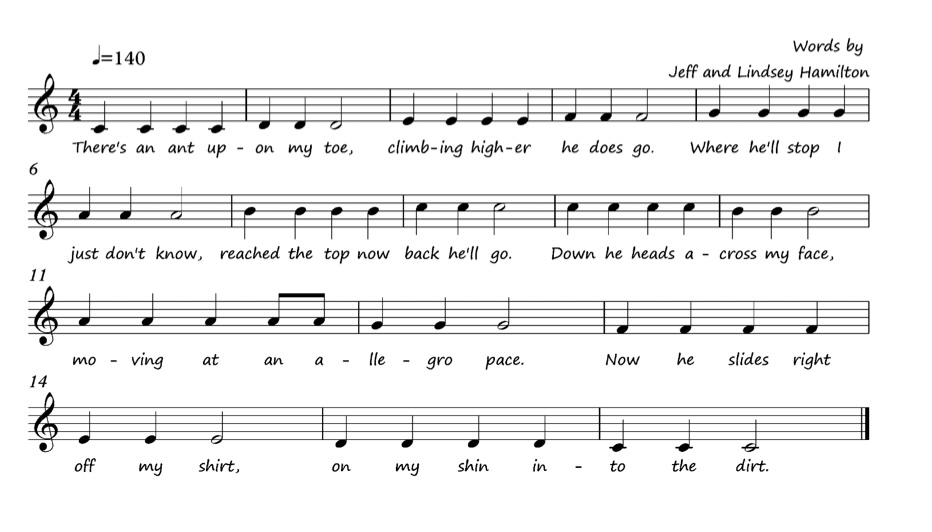
There’s an ant upon my toe,
Climbing higher he does go.
Where he’ll stop I just don’t know,
Reached the top now back he’ll go.
Down he heads across my face,
Moving at an allegro pace.
Now he slides right off my shirt,
On my shin into the dirt.
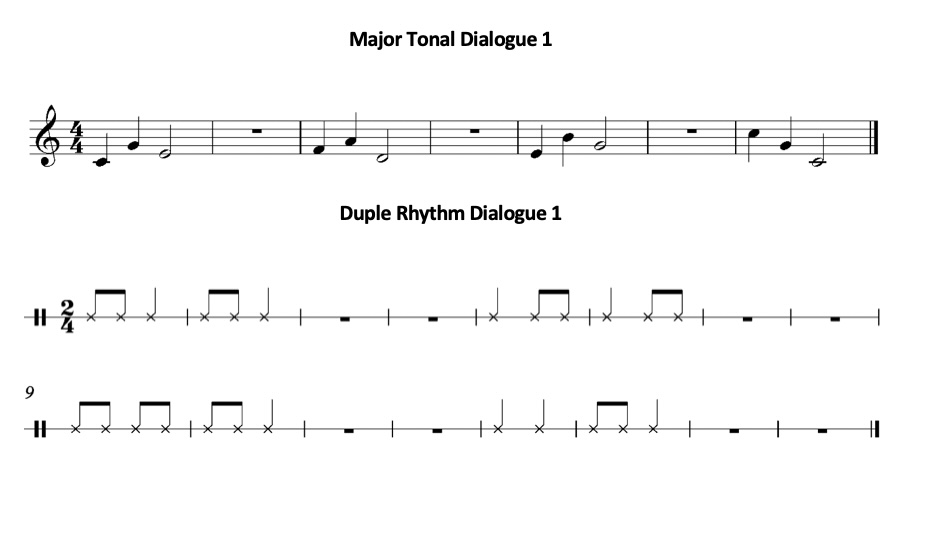
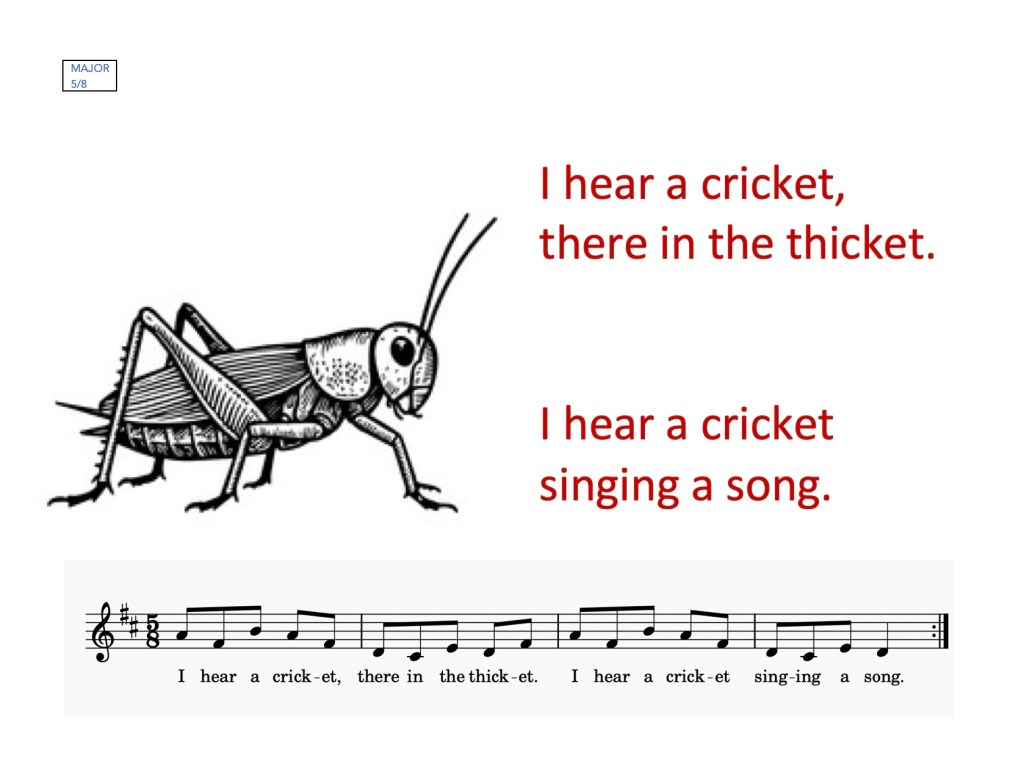
Tonal and Rhythmic dialogues are echo “conversations” you can have with your child. You can take turns being the leader.
A notated example is presented here but you can make up whatever you wish!
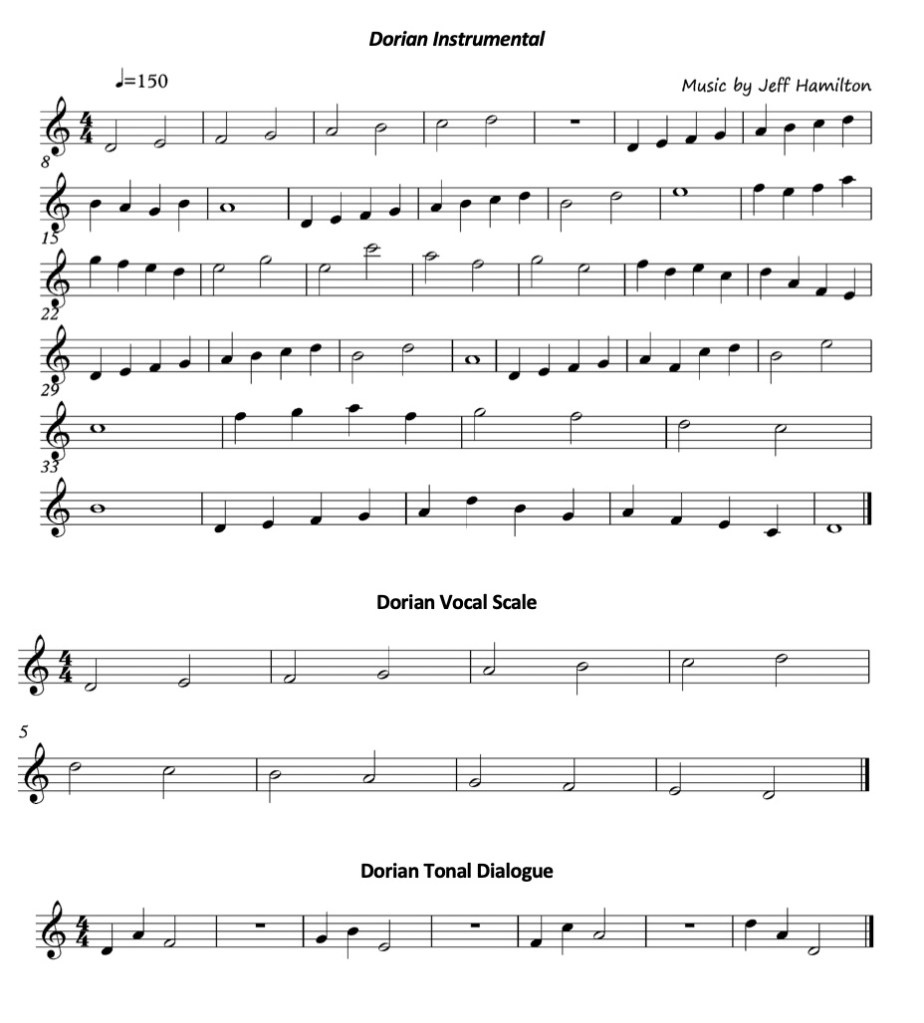
Different tonalities are introduced in this class. The Dorian Mode is a different scale from the major scale, and examples are shown here.
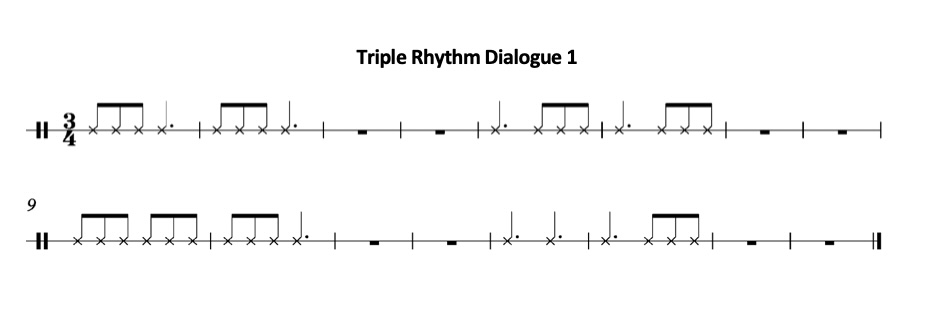
Examples of triple rhythmic patterns that can be used in rhythmic dialogue.
Play a rhythm with rhythm sticks, shaker eggs, drums, tapping on the floor and/or legs, or speak the rhythm pattern on “baa baa” or “taa taa”
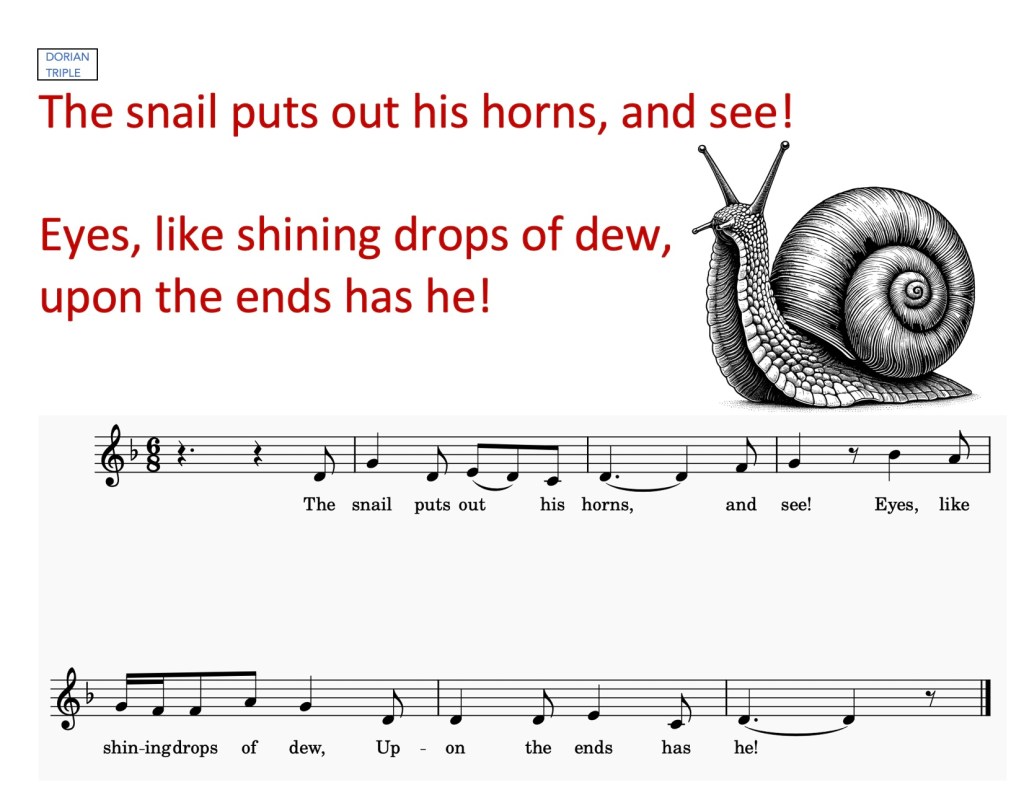
Follow Me!
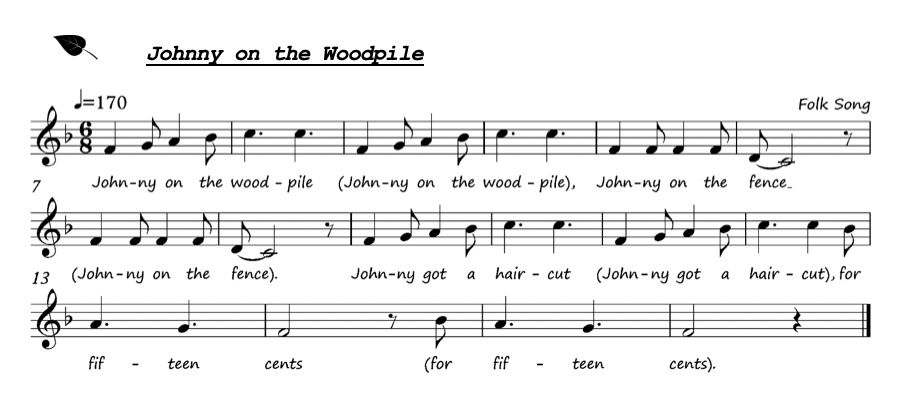
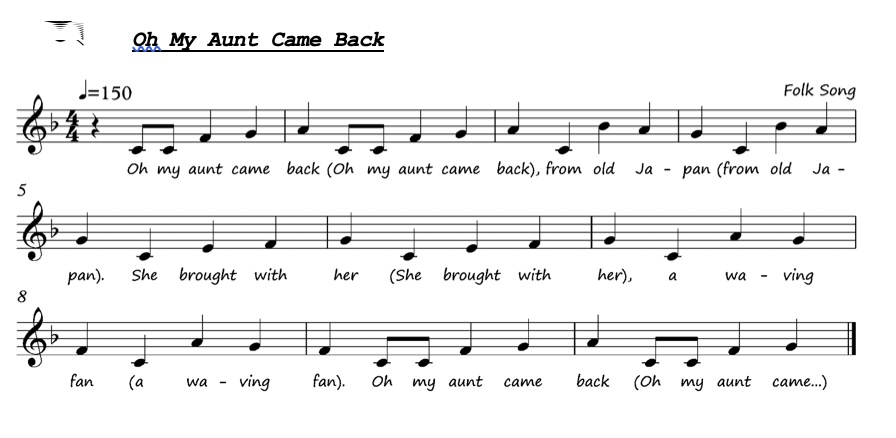
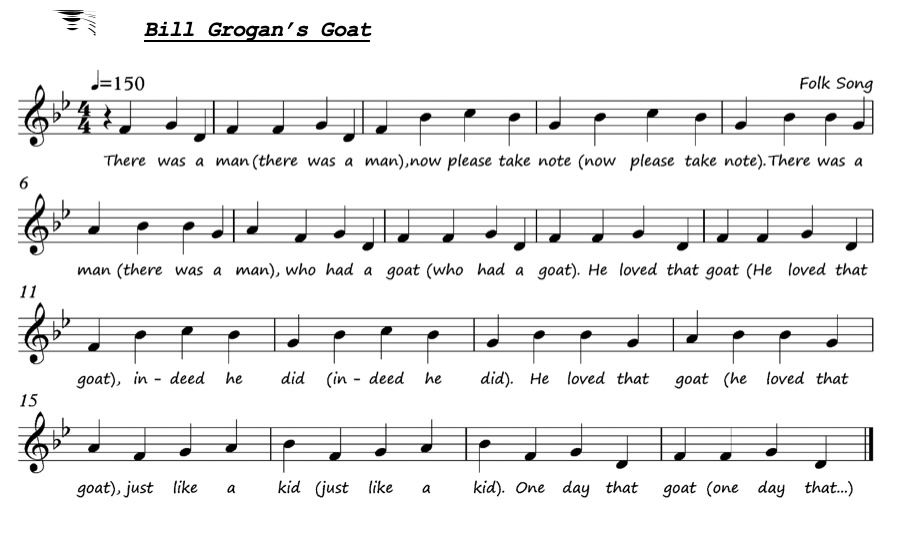
Follow-Me! songs are a great way for children to gain confidence in singing. The leader sings one phrase and the group will echo, or repeat, exactly the same phrase. This is a great skill in listening and pitch matching, as well as following directions.
“I love doing Follow-Me! songs at home with our boys. It is a wonderful opportunity to engage with them in a way where they’re learning to follow directions without it becoming a power struggle. It involves lots to eye contact, and often peals of giggles and laughter. Sometimes I sit down and do these songs with a more formal classroom feeling. Other times I will use the Follow-Me! songs to be transition music. As we’re picking up toys or switching from one activity to another, I will start singing the first line. Instantly the boys start to echo and it makes the work seem much less like work. I also cherish each time I hear their precious little voices singing in unison.”
Johnny on the woodpile (Johnny on the woodpile),
Johnny on the Woodpile
Johnny on the fence (Johnny on the fence).
Johnny got a haircut (Johnny got a haircut),
For fifteen cents (for fifteen cents).
Oh my aunt came back
Oh My Aunt Came Back
From old Japan
She brought with her
A waving fan.
Oh my aunt came back
From Holland, too
She brought with her
A wooden shoe.
Oh my aunt came back
From old Algiers
She brought with her
A pair of shears
Oh my aunt came back
From Guadaloupe
She brought with her
A hula-hoop
Oh my aunt came back
From the county fair
She brought with her
A rocking chair
Oh my aunt came back
From the city zoo
She brought with her
A (let the student choose an animal!) like you!
There was a man
Bill Grogan’s Goat
Now please take note
There was a man
Who had a goat
He loved that goat
Indeed he did
He loved that goat
Just like a kid
One day that goat
Felt frisk and fine
Ate three red shirts
Right off the line
The man, he grabbed
Him by the back
And tied him to
The railroad track
Now when that train
Came into sight
That goat grew pale
And green with fright
He heaved a sigh
As if in pain
Coughed up those shirts
And flagged the train!
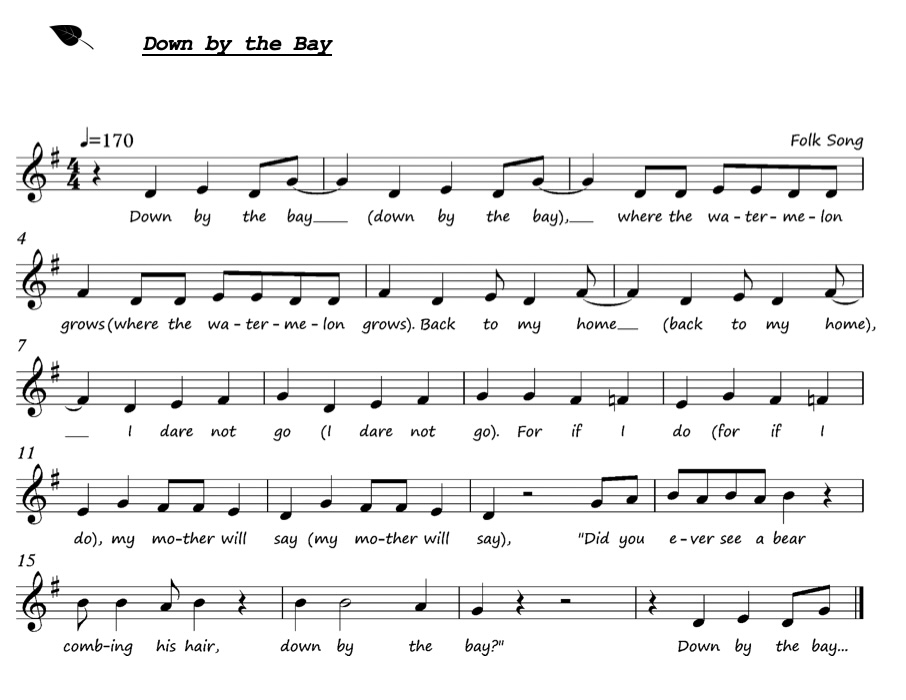
Down by the bay
Down by the Bay
Where the watermelon grows
Back to my home
I dare not go
For if I do
My mother will say
“Did you ever see a bear combing his hair,
Down by the bay?”
…
“Did you ever see a bee with a sunburned knee,
Down by the bay?”
…
“Did you ever see a moose kissing a goose,
Down by the bay?”
…
“Did you ever see a whale with a polka-dotted tail,
Down by the bay?”
Classical Play
Classical Play combines creative play with classical music. We will pretend, move, and explore all while allowing the music to guide us. There may be a few suggested activities to each piece of classical music, but the activity is not at all limited to these.
“If you ever say or think that your child has more energy than you know what to do with, then Classical Play is for you. Classical Play happens almost daily in our home and has since our boys were very little, barely walking even. But on days that it is raining or we have a lot of “work” (school, house or other) to do, I may do a Classical Play activity multiple times in a day. It is a great way to help my very energetic boys release some energy, utilize their creative minds, and laugh.”

- The Descendants of Boreas (Rameau)
- Carnival of the Animals: Aquarium (Saint-Saens)
- Symphony No. 40, K. 550, IV: allegro assai (Mozart)
- William Tell Overture (Rossini)
- Swan Lake, scene (Tchaikovsky)
- Carmen Suite No. 2, II (Bizet)
Vocal Rhythm
This component combines vocal rhythm with specific movement to encourage multi-sensory learning (listening, watching, touching and vocalizing). For the most part, vocal rhythms will be done as a chant, or spoken.
Removing the element of pitch can help the children better understand keeping a beat. These activities are done in varying meters to give the children a wide variety of meter experience.
The benefits of memory work are endless. You can use these vocal rhythm activities to help your struggling reader understand pacing and inflection, or you can use them to break up a long stretch of studying. They are a fun way to engage even your youngest children, as young minds are primed for memorizing, particularly with the correct cadence, inflection, and actions. Speaking of actions, your children will have a great time creating their own motions for these chants.
Chop Chop, Chippity Chop
Chop, chop, chippity chop.
Cut off the bottom,
Cut off the top.
What we have left, we put in the pot.
Chop, chop, chippity chop.
1 2 3 4 5, I Caught A Fish Alive!
One, two, three, four, five,
Once I caught a fish alive.
Six, seven, eight, nine, ten,
Then I let it go again.
Why did you let it go?
Because it bit my finger so!
Which finger did it bite?
This little finger on my right.
Grandma’s Glasses
Here are Grandma’s glasses,
Here is Grandma’s hat.
This is the way she folds her hands,
And lays them in her lap.
Here are Grandpa’s glasses,
Here is Grandpa’s hat.
This is the way he folds his arms,
Just like that!
Five Little Fishies
Five little fishies swimming in a pool,
First one said, “The pool is cool.”
Second one said, “The pool is deep.”
Third one said, “I want to sleep.”
Fourth one said, “Let’s dive and dip.”
Fifth one said, “I spy a ship.”
Fisherman comes, line goes ker-splash,
Away the five little fishies dash!
Singing Songs
Children will build a vocal repertoire by learning to sing traditional songs with beautiful tone and accurate pitch. In addition, they will learn about musicianship of vocal music (dynamics, tempo, tone, etc.). These songs are often familiar, which is an added benefit. It allows for more emphasis on musicianship.
Singing songs is one of the most crucial aspects of the Sound Sprouts curriculum. Children today are bombarded with popular culture and music. Not to say that this is bad, but giving them a repertoire of traditional folk songs is just one way we can attempt to keep the love of music and its history alive.
Introducing folk songs is a wonderful opportunity for a short history lesson. A great way to fit these singing songs into your day is in the car during commutes. Simply listen to the music together and start singing along as you get more confident. Once you know the songs, try adding them into your bedtime story routine. Read a book and sing a song. What a wonderful legacy to help preserve these wonderful songs of history!
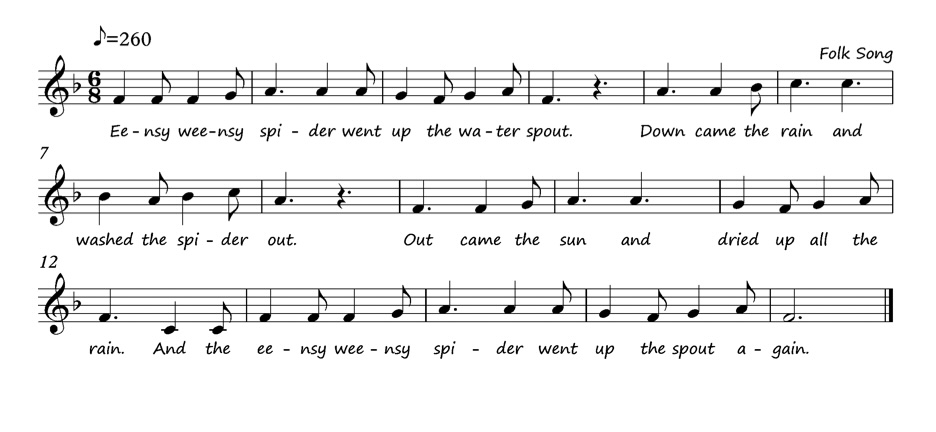
Eensy Weensy Spider
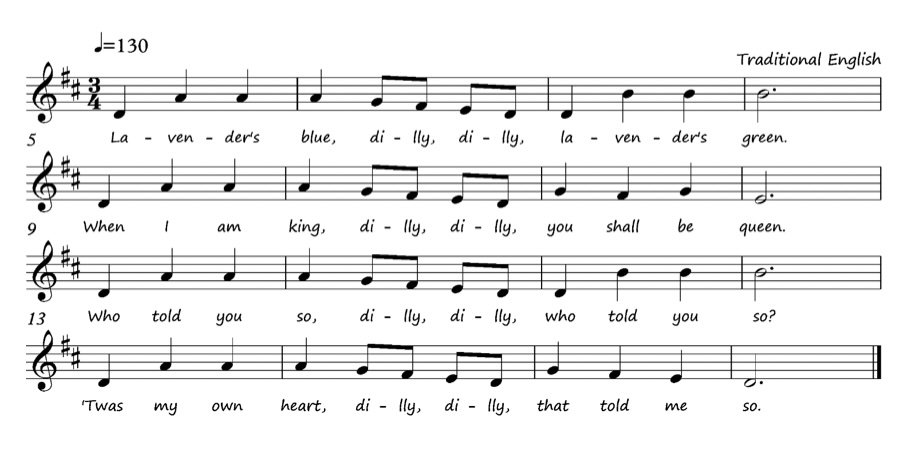
Lavender’s Blue
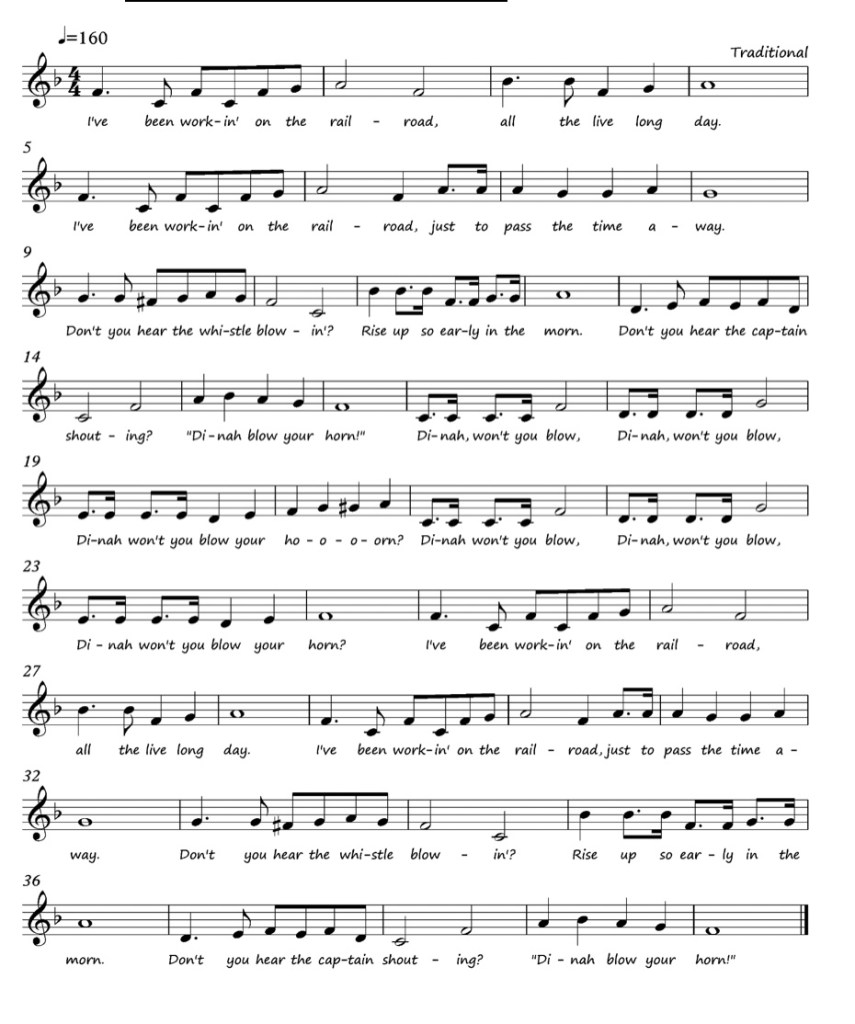
I’ve Been Working on the Railroad
Rhythmic Movement
Using rhythm instruments, children will learn to move and play while staying with the “beat,” watching the teacher to follow directions, and being aware of other children in the class. Sometimes the teacher will lead the group to find the micro (small beat) and other times the macro (big beat).
Rhythmic movement is a great “reward” activity. I’ll often tell our boys that we can get out the rhythm instruments if we finish our regular school work, housework, etc. It’s amazing how motivated they are to finish the other activities. We’ve also used rhythm and movement on days when we can’t get outside because of the weather. Our boys will march around the house playing their instruments for a solid hour while I act as music master, playing the songs they request.
- Turkish March (Beethoven)
- Du and Du Waltz (J. Strauss II)
- Capriccio Espagnol, III, Alborada (Rimsky-Korsakov)
Song Stories
Combining a great story with an unforgettable melody creates the wonder of a Song Story. Some of the song stories have an accompanying book, while others use puppets to tell the story.
- Over in the Meadow
- I Had a Little Rooster
- Once an Austrian Went Yodeling
- Home on the Range
Closing
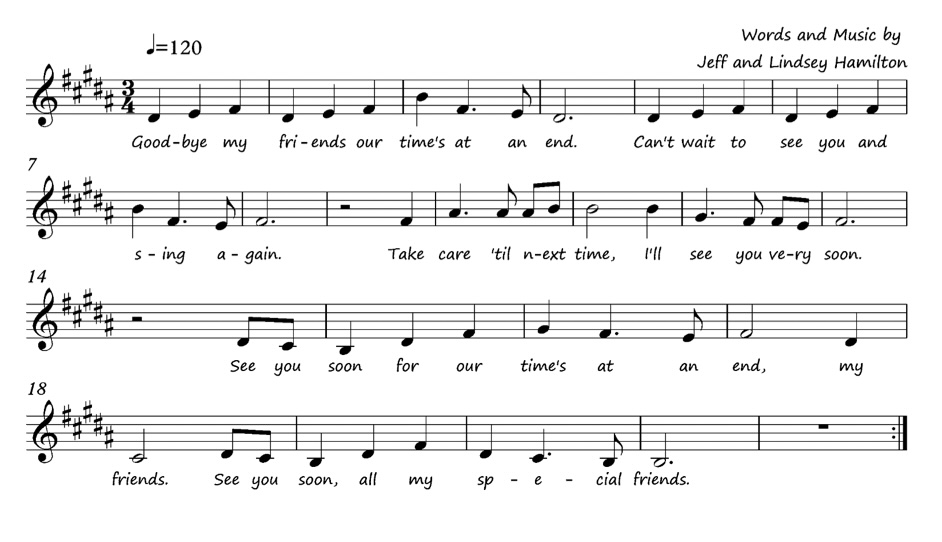
Each class will have a notable ending by singing the Good-bye Song. The song is relaxing, allowing the group to leave calmly, yet inspired.